

Google Ads optimization isn’t a one-time setup: it’s an ongoing process built around how the algorithm’s learning phase works and what signals it’s optimizing against, especially when it comes to the cost per conversion.
Understanding how Google’s ad algorithm actually learns, and what to feed it during that learning phase, is the difference between an account that keeps improving and one that stalls out after month one.
Here’s what that actually looks like in practice.
Sadly, most accounts never get trained properly.
They set it up once, switch on “maximize conversations” and then hope for the best. No wonder people question why the cost per lead doesn’t improve.
Here’s what nobody tells you: Google’s algorithm isn’t smart on day one. It’s smart because someone taught it: click by click, search term by search term, over months, not minutes.
Think of it less like flipping a switch and more like training a new hire. You wouldn’t hand someone your entire ad budget on their first day and walk away. You’d show them what a good lead looks like, correct them when they’re wrong, and give them time to actually learn the job.
Most businesses skip all of that. They turn the algorithm loose with zero guidance and expect it to read minds.
When we take on a new client, we usually only know the basics: what the product is, roughly who it’s for. That’s not enough information to go straight to exact match keywords.
Exact match assumes you already know exactly how people search, and at day one, you don’t.
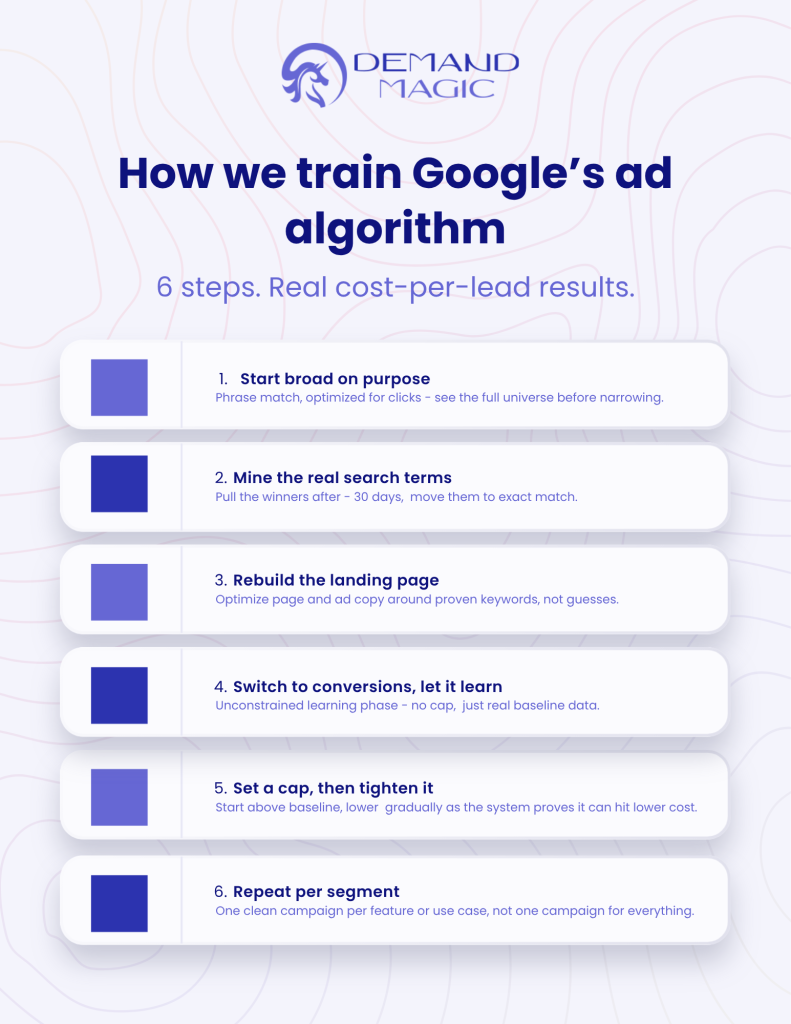
So the first move is putting the core keyword into phrase match, not exact match, and optimizing the campaign purely for clicks. Conversions come later. The goal of this phase is coverage: seeing the full universe of how people actually search for what you sell, instead of guessing.
After roughly a month on phrase match, the search terms report tells you something you couldn’t have known on day one: the actual language your buyers use. Not the language your team assumes they use: the language showing up in real searches.
Pull the ten or so terms that are clearly relevant, add them alongside your original keyword, and move all of it to exact match.
Keep optimizing for clicks for another week or two. This step isn’t about conversions yet. It’s confirming those specific terms actually get traction before you build anything else around them.
This is the step most accounts skip entirely, because it requires going backward before going forward. Once you know the exact terms that get clicks, the landing page and ad copy get rebuilt around that specific language: not the generic messaging that existed before you had any data.
Skipping straight to conversion optimization without this step means asking the algorithm to convert traffic against a landing page that was never built for the searches actually driving it.
Only once the keyword list and landing page are aligned does the campaign objective change from clicks to conversions. This triggers a learning phase, and it needs real time: usually a full month before there’s enough data to act on.
No conversion cap yet. Just a straightforward conversion campaign, unconstrained, so the algorithm can find its own baseline cost per conversion without an artificial ceiling distorting the data.
After 10-15 conversions, a real baseline emerges. Say it lands around $350-400 per conversion. That number becomes the starting point for a maximum cost-per-conversion cap, set slightly above the baseline (breathing room), not at it.
From there, tighten in small increments. If the system is consistently delivering conversions comfortably under the cap, lower the cap.
Each reduction forces the algorithm to get more selective about which keywords and audiences it’s willing to bid on: which is exactly the point. Over two to three months, this consistently narrows down to a handful of keywords that are the real workhorses of the account.
Once one keyword theme is dialed in, the same six-step process gets repeated for each distinct feature or use case the product covers, not folded into the same campaign.
A single broad campaign covering everything dilutes the signal; a separate campaign per segment gives the algorithm a cleaner, narrower job to learn.
None of this compresses into a two-week sprint, and the reason is structural: every step depends on data only the previous step could generate. Here’s what the trajectory looked like on one account we ran through this exact process, a B2B software client with a highly specific niche:
Quarter 1: ~26 conversions, cost per conversion around $300
Quarter 2: cost per conversion rose to roughly $387: the quarter branded search testing began, temporarily raising the blended average
Quarter 3 (36 days in): cost per conversion dropped to roughly $178: nearly half of where it started
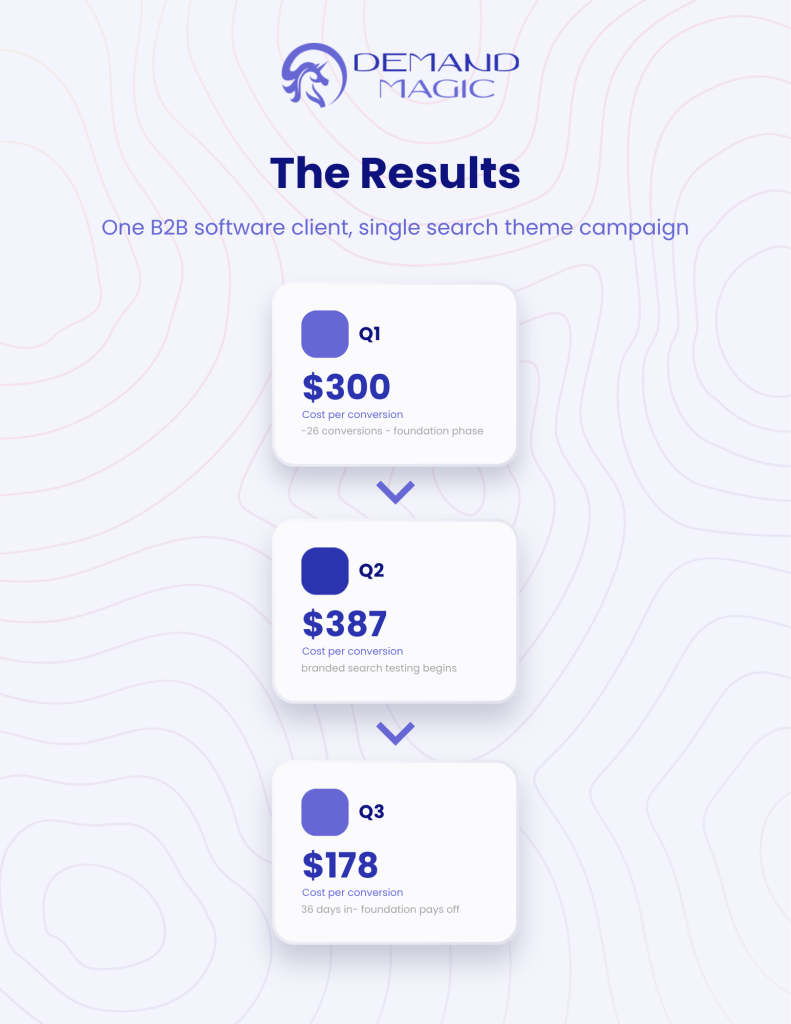
That dip in Q2 wasn’t a failure. It was the foundation-building phase: getting enough people searching for the brand name directly that a branded campaign became worth running at all.
Branded search only works once there’s actual brand search volume to bid against, and building that volume takes time, plus a first year of non-branded campaigns doing the work of making the brand recognizable in the first place.
By the time competitors started bidding on that brand’s own name, a sign the brand had become visible enough to defend, the foundation was already in place to fight back and hold the top position.
Every step in this sequence exists because the step before it created the data the next one needs.
Skip step 2 and you’re optimizing a landing page around guesses. Skip step 4’s unconstrained learning phase and the cap you set in step 5 is arbitrary. Rush toward branded search before non-branded campaigns have built any brand awareness, and there’s no search volume to capture.
Most accounts underperform not because the algorithm is bad, but because nobody gave it a full year of clean, sequential signal to actually learn from.
Even accounts that start the sequence right often unravel it themselves halfway through.
5 common mistakes show up more than any others:
Poor conversion tracking. If the conversion action being tracked is vague, duplicated, or firing on the wrong event, everything downstream is built on bad data. Smart Bidding can only optimize toward what it’s told to count as a win: a broken tracking setup teaches the algorithm to chase the wrong outcome, no matter how clean the keyword strategy is.
Constant budget and cap changes. Every time the daily budget or cost-per-conversion cap gets adjusted, the algorithm re-enters a mini learning phase. Teams that tweak the budget weekly, chasing short-term dips or spikes, never let the system stabilize long enough to actually optimize. Consistency matters more than any single “perfect” number.
Missing negative keywords. Broad and phrase match will keep finding irrelevant traffic unless negative keywords are actively maintained. Skipping this step means paying for clicks the algorithm was never told to avoid: and without that correction, it has no way to learn what “wrong” looks like for your account.
Changing the objective too early. Switching to conversion optimization before the keyword list and landing page are aligned (steps 2 and 3) means asking the algorithm to optimize against a foundation that isn’t ready yet. The data it collects during that mismatch doesn’t get discarded, it gets baked into the model’s early assumptions.
Judging performance too soon. Pulling the plug on a campaign after two or three weeks, before the learning phase completes, resets progress before it has a chance to show results. Most of these mistakes come from the same root cause: impatience with a process that’s built to take months, not days.
Why hasn’t my cost per lead gone down even though I’ve been running ads for months?
Because most accounts never get past the “set it and forget it” stage. The algorithm needs to be actively guided, checked, adjusted, tightened, not just turned on and left alone. If nobody’s been doing that, the lack of improvement makes sense.
What’s the difference between broad match, phrase match, and exact match?
They control how closely a search has to match your keyword before your ad shows up. Broad match casts the widest net: good for discovering what people actually search for, but with little control.
Phrase match is the middle ground, flexible enough to catch real search patterns while still staying relevant. Exact match is the tightest: reserved for keywords you already know to convert, once the guesswork is over.
Is it normal for costs to look worse before they get better?
Yes, and it happens more than people expect. In one account we ran through this process, cost per lead actually went up for a quarter before dropping to nearly half the original cost the quarter after. That “worse” quarter was often the one doing the real groundwork.
How long before I actually see results?
Real, lasting improvement usually takes about a year. The first few months are about figuring out what’s working – the savings show up after that foundation is in place, not before.
Should I just set a tight budget cap right away to control spending?
Not at the start. Without any real data yet, a tight cap just limits how much the algorithm can learn – it doesn’t make it smarter. The cap becomes useful once there’s an actual baseline to tighten from.
Can I just start bidding on my own company name to save money?
Only once people are already searching for your brand by name. Bidding on your own name before anyone’s searching for it doesn’t do much – that visibility has to be earned first through the non-branded campaigns.
DemandMagic runs paid campaigns using this exact sequence: building the keyword and conversion foundation properly before chasing cost efficiency. If your paid account has been “optimizing for conversions” for months with nothing to show for it, book a free marketing session and let’s look at what’s actually happening.
Paid Campaign Management
SEO, AEO
LinkedIn Management
GTM Strategy
Email Marketing
Hubspot Management
Content Creation
Website Migration and Development