

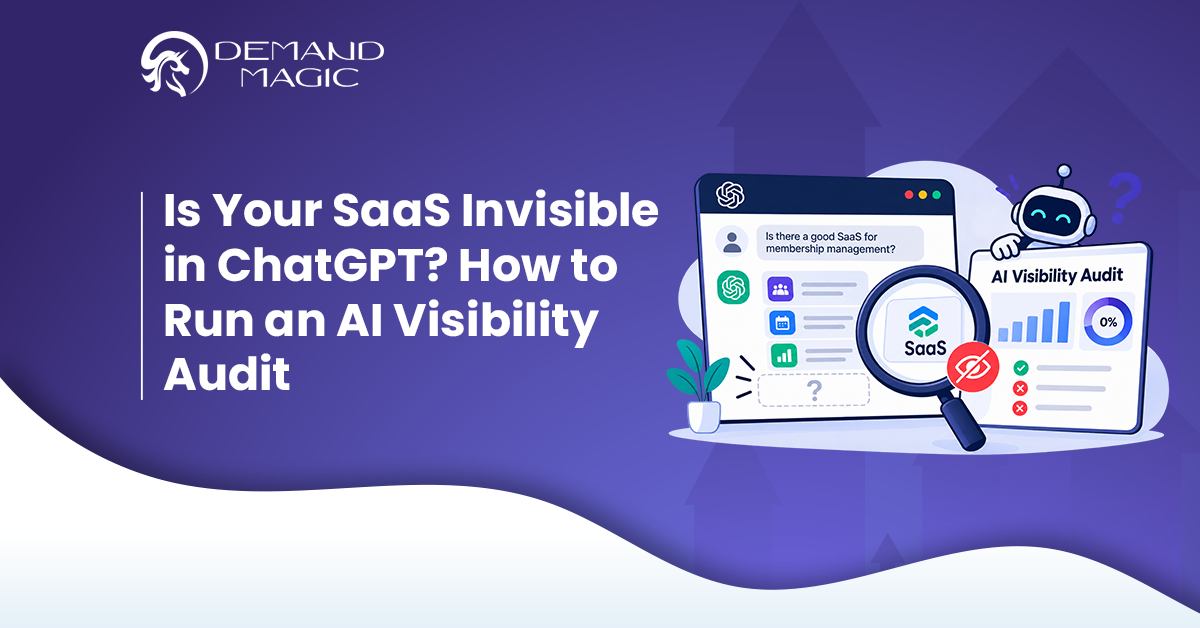
A step-by-step audit you can run this afternoon to see exactly where your SaaS is (and is not) cited across ChatGPT, Perplexity, and Gemini, and who gets named instead.
Here is an uncomfortable exercise: open ChatGPT, ask it for the best tools in your category, and see if your SaaS gets named. For a lot of teams, it does not, but three competitors do. That is pipeline forming on a shortlist you are not on, in a channel you have never checked. The good news is you can measure exactly where you stand in about 30 minutes, with no tools and no budget. This is the step-by-step AI visibility audit, the same process we run for clients, that you can execute yourself today.
An AI visibility audit is a structured check of how often, how accurately, and how favorably AI answer engines like ChatGPT, Perplexity, and Gemini mention your brand when buyers ask for recommendations in your category. It records whether you appear, where you appear, which of your pages get cited, how you are described, and which competitors show up instead. The key difference from an SEO audit: an SEO audit checks whether your pages rank, while an AI visibility audit checks whether the answer names you. A brand can rank on page one of Google and still be completely absent from AI recommendations.
Run an AI visibility audit because a growing share of B2B software research now happens in AI answers, and you cannot fix a visibility gap you have not measured. If buyers are asking ChatGPT for recommendations and your competitor is the one being named, that is a lost pipeline you never see in your analytics. The audit turns an invisible problem into a concrete scoreboard: a mention rate per platform, a list of which competitors beat you, and the exact third-party sources shaping your AI reputation. It is the diagnostic that should come before any answer engine optimization works, because it tells you what to fix first.
Run an AI visibility audit in five steps: build a buyer-prompt set, run it across engines in clean sessions, log mentions and citations, trace the sources, and score your gap against competitors. You need about 30 minutes, a spreadsheet, and free accounts on the major engines. Here is the exact process.
List 15 to 20 prompts your buyers would actually type, across three types: category prompts, comparison prompts, and brand-check prompts. These are the questions that decide shortlists:
Run every prompt on ChatGPT, Perplexity, and Gemini (add Google AI Overviews and Claude if you can), using logged-out or incognito sessions so your own history does not skew results. Run each prompt a few times, because answers vary between runs. Perplexity deserves special attention: it cites its sources inline, which makes it the most measurable engine in the audit.
For every prompt and engine, record whether your brand is mentioned, where it appears (first or last), how it is described, and which competitors appear. A simple grid works: prompts down the side, engines across the top, and in each cell note mentioned/not, position, and sentiment. This grid is your baseline and the scoreboard you will re-run monthly.
| Log for each prompt | What to record |
|---|---|
| Mention | Is your brand named in the answer? Yes/No |
| Position | First-mentioned, mid, or last among the named brands |
| Sentiment | How you are described: positive, neutral, inaccurate |
| Competitors | Which rivals appear when you do (or do not) |
| Citations | Which URLs/sources the answer links to (Perplexity shows these) |
Use Perplexity’s cited source list to see which third-party sites are shaping what AI says about you, because those sources, not your own website, are what drive most citations. This is the single most useful data point in the whole audit. If G2, a specific publication, or a Reddit thread keeps getting cited for your category, that is where your visibility is won or lost. Owned content alone rarely moves it, which is the core lesson of how to rank on ChatGPT.
Calculate your mention rate per platform, compare it to your top competitors, and prioritize fixes by your weakest prompt across engines, not your weakest single engine. A low score on one platform may be a quirk; a prompt where you lose across all engines is a real content and authority gap. One caution on reading the results: visibility varies wildly by engine. Per Superlines 2026 data, the same brand can score 0.769 sentiment on Perplexity and 0.052 on ChatGPT, a 14.8 times gap, so never judge your AI presence from a single platform.
After the audit, fix the highest-impact gaps in order: correct inaccurate brand descriptions, build third-party presence where competitors are cited, and make your key pages answer-first and extractable. The audit tells you exactly where to start. If the engines describe you wrong, fix your entity consistency first. If competitors dominate category prompts, you have a third-party authority gap. If you are absent despite good content, your pages probably are not extractable. Each finding points to a specific fix, which is the work an AEO agency or your own team takes from here.
Re-run your AI visibility audit monthly, because AI answers change frequently and a single check is only a snapshot. Keep the same prompt set and spreadsheet so the numbers are comparable over time. Monthly cadence turns the audit from a one-time scare into a trend line that shows whether your AEO work is actually moving your citation share.
An AI visibility audit replaces a vague worry (“are we even in ChatGPT?”) with a concrete scoreboard you can act on. Build a buyer-prompt set, run it across engines in clean sessions, log mentions and sources, and score your gap against competitors. Thirty minutes tells you whether you are on the shortlist AI is building for your buyers, and the Perplexity source list tells you exactly where to go to fix it. Run it today, run it monthly, and you turn AI search from a blind spot into a channel you manage.
Yes; a manual audit across ChatGPT, Perplexity, and Gemini in incognito sessions needs only free accounts and a spreadsheet. Paid tools like Ahrefs Brand Radar or Semrush AI Toolkit earn their cost when you need large prompt sets or continuous multi-platform tracking, but they are not required for a solid first audit.
An SEO audit checks whether your pages rank in search results; an AI visibility audit checks whether AI answers name and recommends your brand. You can pass one and fail the other, which is exactly why both matter in 2026.
Because Perplexity leans on live web retrieval while ChatGPT leans more on training-data memory, so recent coverage helps Perplexity faster. This is why single-platform audits mislead and you should always test across engines.
Mention rate on buyer-intent category prompts, because that is where shortlists form. Being named when a buyer asks “best tools for X” matters far more than being described accurately on a branded query.
| Want your SaaS to show up when buyers ask AI for the best option? As a demand generation agency for B2B SaaS, we run AI visibility audits and build AEO programs that turn invisibility into citations and pipeline. Book a strategy session → |
 Sam