

Why most demand-gen advice fails SaaS teams, and the motion-first framework that doesn’t.
Here’s the uncomfortable pattern we see across SaaS demand-gen audits. A team copies a “proven” demand-generation playbook that’s usually built for a different company’s motion. They execute it as explained or directed to, and watch the pipeline stay flat. The tactics aren’t broken. The fit is.
A freemium PLG tool running enterprise-style ABM, or a six-figure-ACV platform relying on self-serve content, is doing good work against the wrong economic model.
So this isn’t another list of channels. It’s a framework for deciding which demand engine you’re actually running before you spend a dollar building it. We call it the Motion-Fit Demand Framework, and it’s the model our other SaaS strategy pieces build on.
A B2B SaaS demand generation strategy is the system that creates, captures, and converts buyer demand into a qualified pipeline that’s calibrated to your specific GTM motion, average contract value, and buyer segment. It’s not a channel plan. The channels (content, paid, ABM, community, product-led loops) are downstream of one decision: which motion your unit economics can actually afford.
That last clause is where generic advice falls apart. A strategy that ignores motion and ACV will over-invest in the wrong stage of the funnel and call it a demand problem when it’s a fit problem.
The order matters. Each layer constrains the one below it. Teams that skip to layer three, or the pipeline math, without settling on layer one end up with beautifully instrumented dashboards measuring an engine that was never going to work.
Your ACV determines your motion, and your motion determines your entire demand engine. The rough 2026 thresholds: PLG for ACV under ~$10K, sales-led above ~$25K, and hybrid for the band in between, which, as Salesmotion’s 2026 GTM analysis notes, is now where most B2B SaaS actually sits. Get this line right and the rest of the strategy follows; get it wrong and you’re funding a motion your margins can’t sustain.
The reason is unit economics, not preference. PLG works when the product can sell itself. It’s simple enough to adopt without training, and cheap enough to approve without a buying committee. Sales-led becomes necessary when deals involve multiple stakeholders, security reviews, and procurement. No amount of content closes a $50K purchase that legal has to sign off on.
What most SaaS teams get wrong here
They treat motion as a marketing style choice rather than an economic constraint. Ray Rike’s 2025 SaaS marketing benchmarks put PLG companies at a median 13% of revenue on marketing versus ~9% for sales-led, but that headline hides the real point: PLG shifts spend into the product and activation, while sales-led shifts it into pipeline and SDR capacity. Copying a PLG content budget onto a sales-led motion starves the exact function that closes your deals. The percentages aren’t the lesson; where the money has to live is.
Motion fit at a glance (2026 thresholds) PLG: ACV < ~$10K · product drives signups · spend goes to activation & self-serve conversion. Hybrid: ~$10K–$25K ACV · product acquires, sales expands · the modal B2B SaaS motion in 2026. Sales-led: ACV > ~$25K · multi-stakeholder, procurement-gated · spend goes to pipeline & SDR capacity. |
You build for the anonymous phase, because that’s where the decision is now made. Forrester and Gartner data compiled by Similarweb converge on the same finding: B2B buyers complete roughly 70–80% of their purchase journey before ever contacting sales. By the time a form is filled, the shortlist is often already set. A demand strategy that only activates after the hand-raise is competing for deals that were decided in channels it never touched.
Those channels are the “dark funnel”: peer communities, Slack groups, podcasts, LinkedIn DMs, and increasingly AI answer engines. As a proxy for how large this is, Similarweb finds direct traffic (the closest measurable stand-in for dark, unattributed word-of-mouth) accounts for over 70% of visits to Gong, HubSpot, and Outreach. Most of the most aggressively marketed SaaS companies in the world are acquired through channels their attribution can’t credit.
Paid’s share of B2B SaaS pipeline has fallen from roughly 34% in 2023 to about 26% today, while organic search, content, and AEO have climbed to around 27%. The top-quartile SaaS teams now attribute 41% of qualified pipeline to those owned channels combined, per the FirstPageSage SaaS Demand Report 2026.
Here’s what most teams get wrong: they read “invisible” as “unmeasurable” and therefore “not worth funding.” That’s backwards. The dark funnel isn’t a measurement gap to close; it’s a demand surface to occupy. Being consistently present where your ICP discusses problems, and being the brand cited when they ask an AI engine “best tools for X”, is what puts you on the shortlist before outbound ever fires. For a demand-gen agency, this is the whole game: the brands cited in answer engines are the brands in the consideration set.
From framework to pipeline This is the layer where an interpreted benchmark earns its keep. When we audit a SaaS demand engine, the first question isn’t “how many MQLs?”, its “what share of your ICP’s anonymous research surface do you actually occupy?” Ready to build your demand engine? Book a free strategy session → |
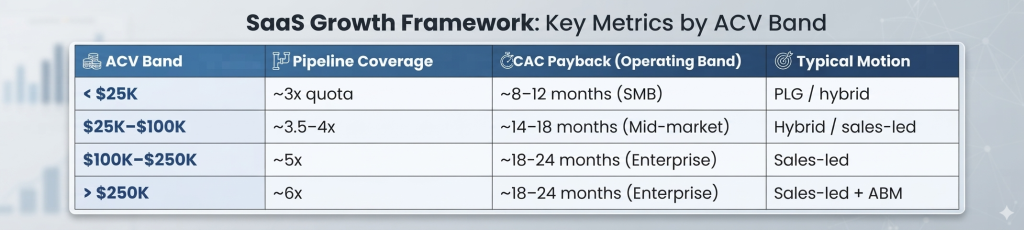
Stop using one company-wide coverage number. Pipeline coverage should scale with ACV: roughly 3× quota under $25K ACV, 3.5–4× at $25K–$100K, 5× at $100K–$250K, and 6× for enterprise above $250K, per GROU’s 2026 pipeline benchmarks (calibrated on 1,400 tracked deals). The most common cause of quota miss in mid-market SaaS is setting a flat 3× and quietly underfunding enterprise pipeline by half.
CAC payback follows the same segment-specific logic. The all-B2B-SaaS median sits around 15–16 months, per the Aleph × Benchmarkit 2026 benchmarks, but the median is nearly useless on its own: top-quartile companies recover CAC in 6 months while the worst case in the sample takes 48. Broken out by segment, the operating bands look like: SMB roughly 8–12 months, mid-market 14–18, enterprise 18–24.
They benchmark against the wrong peer. As Spike AI’s 2026 benchmarks put it, a self-serve PLG company comparing itself to an enterprise field-sales median will look either catastrophically inefficient or implausibly efficient, and neither read is true. What’s worse is that CAC has been inflating industry-wide. The median new-customer CAC ratio has climbed to roughly $2.00 of sales-and-marketing spend for every $1.00 of new ARR, up double digits year over year. If your payback is drifting, it may be the market, not your team; but only segment-level tracking tells you which. A blended number hides the answer.
Measure sourced-share, NRR, and segmented CAC payback, not MQL volume. MQL count is the metric most likely to look healthy while pipeline dies, because it rewards lead quantity over ICP fit. As Spike AI notes, a low MQL-to-SQL rate is usually a scoring or definition problem, not a top-of-funnel one, so pouring more leads in makes the dashboard greener and the pipeline no better.
The durability metric that’s replaced raw growth on SaaS board decks is net revenue retention. The 2026 bar: top performers target NRR of 110%+, with the best above 120%, and, per the KeyBanc 2026 SaaS survey, top-NRR-quartile companies grow about 2.3× faster than peers stuck at 95–100%. For demand gen, the implication is blunt: acquisition that ignores retention is a leaky engine, because NRR is what decides whether the CAC you just spent was worth spending.
Work the four layers in order, and let each one constrain the next. In practice that’s four questions, answered before you touch a channel plan:
If any answer is “we’re not sure,” that’s the layer to fix first. Long before adding channels on top of an engine that isn’t calibrated.
Demand generation doesn’t fail SaaS teams because the tactics are wrong. It fails because the strategy is motion-blind. The plays are fine, but they’re fitted to an economic model that isn’t yours. Fix fit first: settle your motion, build for the anonymous buyer, run segment-specific pipeline math, and measure the metrics that actually predict durable revenue. The channels get dramatically easier once the engine underneath them is the right one.
DemandMagic runs focused, sustainable social media programs for B2B brands who’d rather go deep on the platform that matters than spread thin across five. If your team is stretched across too many channels with too little to show for it, book a free marketing session and let’s fix that.
Paid Campaign Management
SEO, AEO
LinkedIn Management
GTM Strategy
Email Marketing
Hubspot Management
Content Creation
Website Migration and Development