"Be Everywhere on Social" Is How Brands Burn Out Their Team and Budget
“We should be on LinkedIn, Instagram, TikTok, X, and YouTube” sounds like ambition. It’s actually a resourcing problem wearing a strategy costume.
Being everywhere isn’t a channel strategy. It’s the absence of one – dressed up to look thorough in a board deck.
This post breaks down why a focused, single-platform social media strategy – usually anchored on LinkedIn – consistently outperforms a scattered, spray-and-pray content strategy for B2B brands.
Why Managing Multiple Social Platforms Overwhelms Small Marketing Teams?
Most social teams are small. Industry research shows the majority of social teams have fewer than six people, and most experience burnout at least occasionally. Spread that team across five platforms, each with its own format, algorithm, and posting cadence, and you haven’t built a five-channel strategy. You’ve built five understaffed strategies running at once.
Every platform you add doesn’t split the workload: it multiplies it. different aspect ratios, different caption lengths, different best-posting-times, different comment sections to monitor.
The team doesn’t get five times the reach. They get five times the context-switching and a fraction of the depth on any one platform.
Why Posting Everywhere Hurts Content Quality?
Here’s the part that doesn’t show up in the planning meeting:
Content quality drops the moment a team starts producing for volume across channels instead of for fit on one.
A LinkedIn post written to also work as a TikTok script, an X thread, and an Instagram carousel ends up serving none of them well. Each platform rewards a different kind of content: and buyers can tell the difference between something built for their platform and something recycled to fill a content calendar.
The irony is that “being everywhere” usually produces less total engagement than being excellent in one place, not more. Thin content across five feeds loses to sharp content in one.
Why a Focused B2B Social Media Strategy Performs Better?
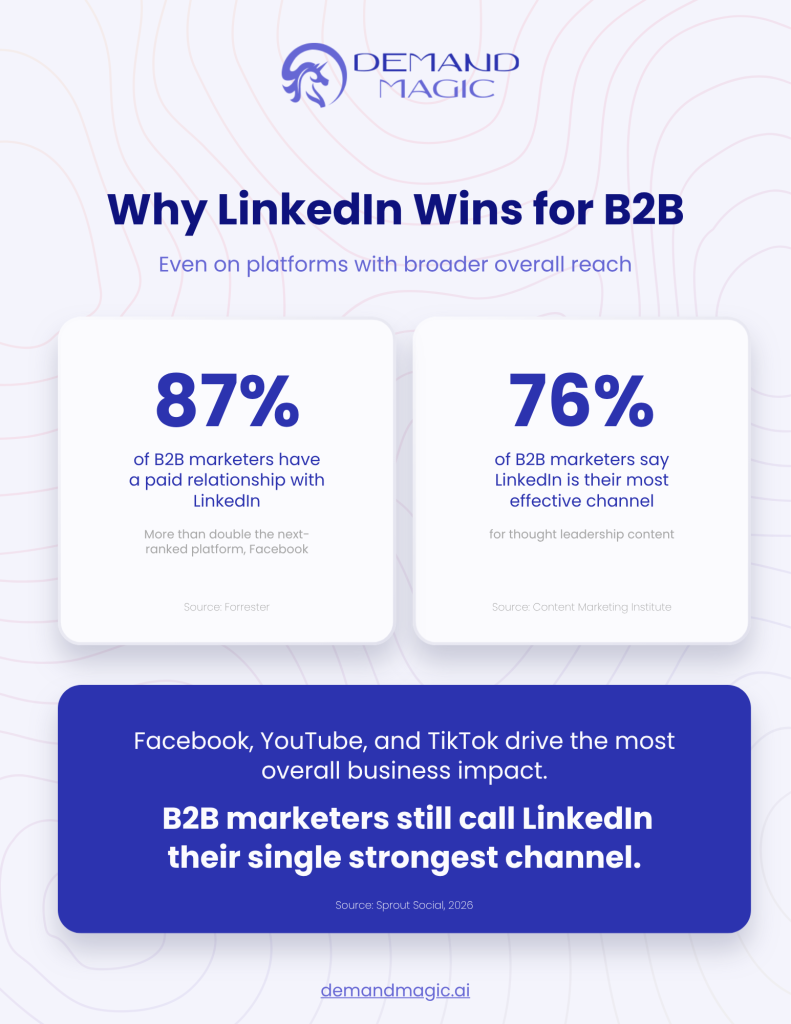
Not all platforms carry equal weight for B2B.Sprout Social’s 2026 research found that while platforms like Facebook, YouTube, and TikTok drive the most overall business impact across industries, B2B marketers consistently name LinkedIn as their single strongest channel. That’s not a coincidence: it’s where B2B buyers, not just consumers, actually spend professional attention.
Trying to “cover” every platform equally means splitting resources evenly across places that don’t return equal value.
A B2B brand spreading effort evenly across LinkedIn, Instagram, and TikTok is choosing to be mediocre on the one platform that matters most, in exchange for a presence on two that mostly don’t.
After 10-15 conversions, a real baseline emerges. Say it lands around $350-400 per conversion. That number becomes the starting point for a maximum cost-per-conversion cap, set slightly above the baseline (breathing room), not at it.
From there, tighten in small increments. If the system is consistently delivering conversions comfortably under the cap, lower the cap.
Each reduction forces the algorithm to get more selective about which keywords and audiences it’s willing to bid on: which is exactly the point. Over two to three months, this consistently narrows down to a handful of keywords that are the real workhorses of the account.
What Focus Actually Looks Like?
Focus isn’t “post less.” It’s “post less often, on fewer platforms, with more intent.”
In practice:
Pick the one or two platforms where your actual buyers show up — not where the most impressive follower count is easiest to build.
Set a cadence your team can sustain indefinitely, not a burst that burns everyone out in month two.
Build content specifically for the platform’s format, instead of one asset repurposed five ways.
Measure depth, not spread — engagement quality and pipeline influence on your core channel beats vanity reach across five.
This is the thinking behind well-runsocial media management programs: fewer platforms, done properly, consistently, beats a scattered presence everywhere that nobody has the bandwidth to sustain.
Fewer Platforms, Done Properly, Wins
“Be everywhere” feels safer in a planning meeting because it sounds like you’re not leaving anything on the table. In practice, it’s the version of the strategy most likely to burn out your team, blow the budget, and still underperform a focused approach on the one platform your buyers actually use.
Pick your platform. Show up consistently. Go deep instead of wide.
How many social platforms should a B2B brand actually be active on? For most B2B brands, one to two platforms done well outperforms five done thinly. LinkedIn is typically the anchor; a second platform only makes sense if there’s clear evidence your buyers are actually there.
Isn’t more platforms just more brand visibility? Only if the content on each platform is strong enough to earn attention. Thin, recycled content across many platforms usually produces less total engagement than focused content on one — visibility without substance doesn’t convert.
What’s a realistic posting cadence for a small team? A cadence the team can sustain for a full year without burning out is more valuable than an aggressive schedule that collapses in month three. Three focused posts a week on one platform beats daily posts spread across four.
How do we know which platform is actually right for our audience? Look at where engagement and inbound conversations are already happening, not just where competitors post. For most B2B categories, that’s LinkedIn — but this should be checked against your own audience data, not assumed.
Does focusing on fewer platforms limit growth long-term? No — it usually accelerates it. A strong presence on one platform builds the audience, proof points, and content library that make expanding to a second platform far easier later, rather than starting five weak presences from zero at once.
DemandMagic runs focused, sustainable social media programs for B2B brands who’d rather go deep on the platform that matters than spread thin across five. If your team is stretched across too many channels with too little to show for it,book a free marketing session and let’s fix that.
DemandMagic is an innovative B2B marketing and demand generation agency located in the United States, where we combine our expertise in integrated marketing solutions with creative strategies to craft exceptional online experiences. Explore how we transform insights into meaningful results!
Office:
12349 Chirping Bird ln,
Knoxville, Tennessee 37932, US